 Free SEO Audit
  Popular
 SEO
SEO
 Google Ads Management
 Ecommerce SEO
 Web Design Service
 White Label SEO

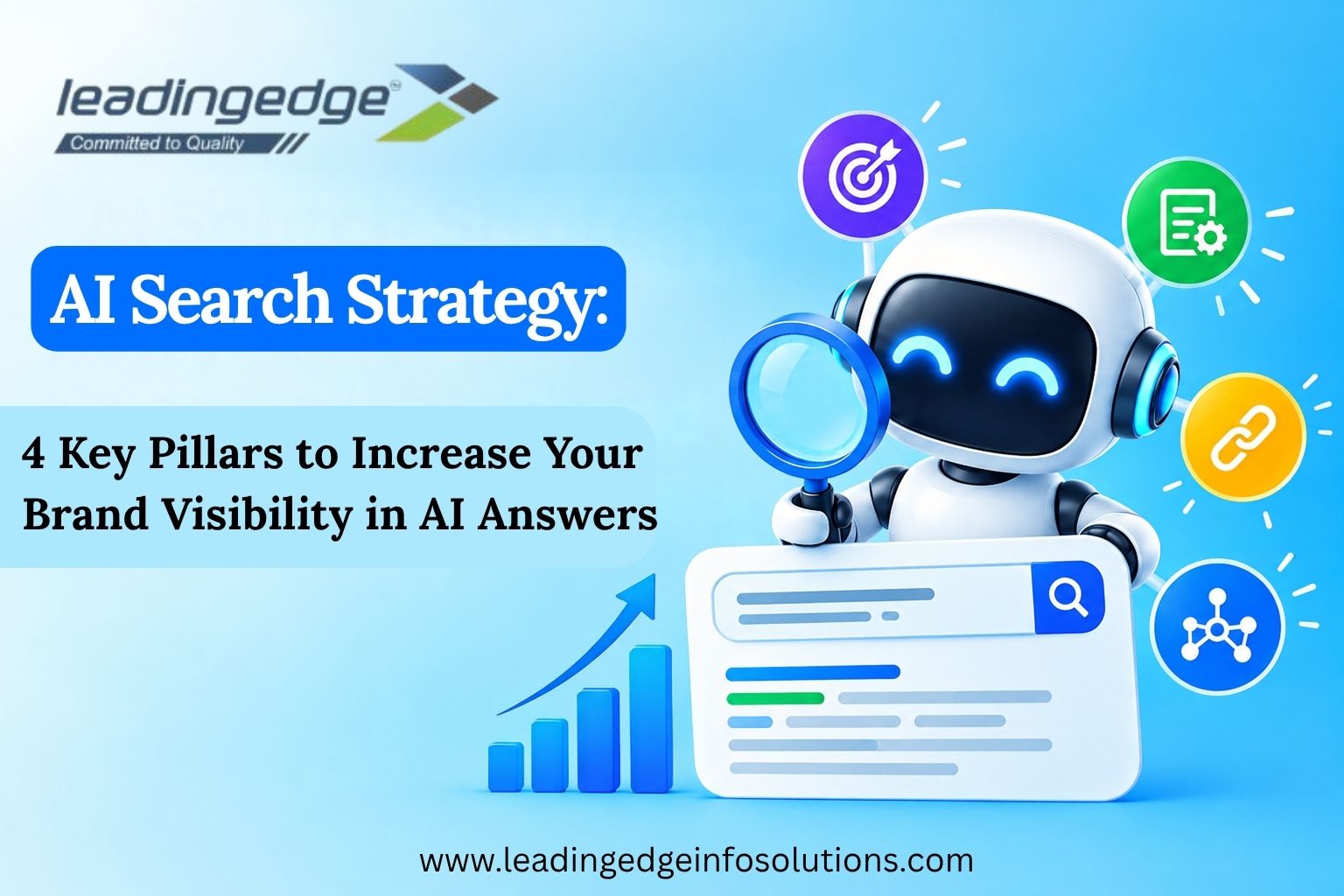
Your brand can rank on Google’s first page and still miss out on valuable search visibility. As search behaviour is changing, people now turn to ChatGPT, Perplexity, or Google’s AI Overviews for recommendations, comparisons, and answers without visiting several websites. That means traditional SEO alone may no longer be enough to capture every opportunity.
An effective AI search strategy helps your brand become more visible within these AI-generated answers by combining strong content, clear information, brand authority, and technical SEO. Instead of focusing only on where your website ranks, the goal is to make your business a credible source that AI systems can understand, trust, and reference. Here are four key pillars to build that visibility.
- AI search assembles answers from multiple sources instead of just ranking pages, so being quotable matters as much as being ranked.
- Answer-ready content, direct answers near the top of each section, in plain language, is far easier for AI to lift and cite.
- A consistent, well-defined entity (name, address, credentials, structured data) makes AI more confident recommending your business.
- Technical access matters: if crawlers are blocked or content hides behind JavaScript, AI tools can’t cite what they can’t reach.
- Mentions beyond your own site (PR, reviews, forums, podcasts) build AI trust in ways backlinks alone don’t fully capture.
- Measure citations and share of voice with a fixed set of prompts monthly. Rankings alone won’t show whether your AI visibility is improving.
How AI Search Differs From Traditional Search
Traditional search ranks pages. AI search assembles answers. Large language models (LLMs) write the reply, often using retrieval-augmented generation (RAG), which pulls passages from live web pages and blends them into one response. To be visible, your brand must be quoted as a source or named as a recommendation.
This changes the goal. A page can rank well and still never be cited, while a smaller site with a clear, trusted answer can be quoted alongside bigger competitors. The good news is that fundamentals still count: AI features in Google Search draw on the same index and quality signals as regular search, so sound SEO remains the foundation.
| Did You Know? AI search tools don’t crawl the web live for every answer. Most rely on indexes built from Google, Bing, and their own crawlers, so if your site is blocked or thin, you’re invisible before the AI even starts writing its response. |
Pillar 1: Create Answer-Ready Content
AI systems extract passages, so your content needs to be easy to lift. Picture a family dental clinic. A page titled “How much does a dental implant cost?” that opens with a clear two-sentence answer, then explains the factors, is far easier to cite than a page that circles the topic before getting to the point.
To make content answer-ready:
- Lead with the answer. Put a direct, plain-language response under each heading, then add detail.
- Match real questions. Use question-style headings that reflect how people phrase prompts, and cover likely follow-up questions on the same page.
- Add original value. Include first-hand experience, local data, pricing ranges, comparisons, or expert commentary that a generic summary cannot supply.
- Keep it fresh. Review key pages regularly and update facts, dates, and examples, because AI tools tend to prefer current information.
- Add an FAQ section with short, self-contained answers.
Pillar 2: Strengthen Your Entity Authority
An entity is a clearly defined thing, such as a business, person, product, or location, that search engines and AI systems can recognize and connect to facts. When your entity is well defined, AI is more confident about who you are and what you are known for.
Build it by:
- Keeping details consistent. Use the same business name, address, phone number, services, and description across your website, Google Business Profile, social profiles, and directories.
- Adding structured data. Schema markup such as Organization, LocalBusiness, Service, Person, and FAQPage helps machines read your pages accurately.
- Showing real expertise. Publish author bios, credentials, case studies, and reviews to strengthen E-E-A-T (experience, expertise, authoritativeness, and trustworthiness).
- Owning your topic. Build topical authority with connected content clusters, so your site covers a subject in depth instead of through one-off posts.
Is your brand entity even recognizable to AI?
We’ll run a free AI visibility check across ChatGPT, Perplexity, and Google AI Overviews to see where your business stands today.
Pillar 3: Make Your Site Easy for AI to Access
AI engines cannot cite what they cannot reach. Technical health is a quiet but important part of any AI search strategy. Check that:
- Crawlers are allowed. Check robots.txt for GPTBot, PerplexityBot, and Google-Extended specifically. Many sites block AI crawlers by accident through a generic “disallow all bots” rule left over from an old security setup. Whether to allow each AI crawler is a business decision, so make it deliberately.
- Key content loads as plain HTML. Important text hidden behind heavy JavaScript, tabs, or pop-ups may not be read reliably.
- Pages are fast and mobile-friendly, with clean structure, logical heading order, and working internal links.
- Indexing is healthy. Keep sitemaps updated and remove duplicate, thin, or broken pages that weaken your signals.
Bing deserves attention too. Microsoft Copilot is built on it, and some other assistants have relied on Bing results, so submitting your site to Bing Webmaster Tools is a low-effort step.
| Pro Tip: Run a quick fetch-as-bot test using a free user-agent switcher or a tool like Screaming Frog. If key pages return a blank or JavaScript-only shell instead of readable text, that’s exactly what an AI crawler sees too, even though your browser shows a fully loaded page. |
Pillar 4: Earn Mentions Beyond Your Own Website
AI engines do not rely on your website alone. They also read what the wider web says about you. Independent mentions act like votes of confidence, and analyses from SEO software vendors have suggested that brand mentions across the web track AI visibility more closely than backlinks alone.
Ways to earn them:
- Digital PR and expert commentary. Contribute quotes, data, and guest articles to respected industry publications.
- Reviews and directories. Encourage genuine reviews on Google, Trustpilot, and sector-specific platforms.
- Community presence. Answer questions helpfully on forums such as Reddit and Quora, follow each community’s rules, and be open about your affiliation. Never spam.
- Partnerships and podcasts. Appear where your audience and industry peers already look for advice.
How to Measure AI Search Visibility
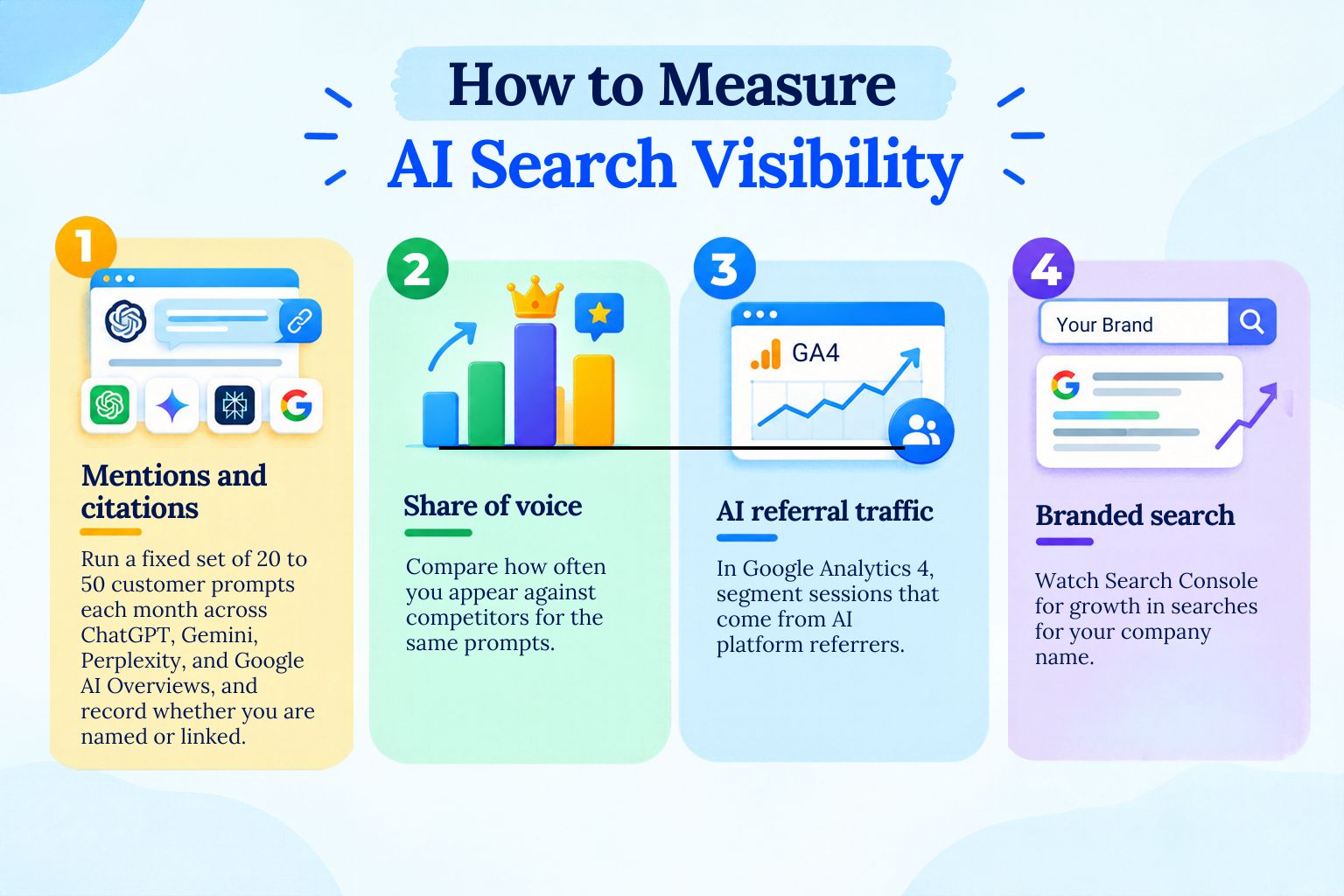
Rankings alone will not show whether your strategy works. Track:
- Mentions and citations. Run a fixed set of 20 to 50 customer prompts each month across ChatGPT, Gemini, Perplexity, and Google AI Overviews, and record whether you are named or linked.
- Share of voice. Compare how often you appear against competitors for the same prompts.
- AI referral traffic. In Google Analytics 4, segment sessions that come from AI platform referrers.
- Branded search. Watch Search Console for growth in searches for your company name.
AI answers vary between runs and platforms, so look for trends over time rather than single results, and treat any tool’s numbers as estimates.
| Pro Tip: Log which AI Overview or citation links back to your site versus just naming your brand with no link. A named mention with no click-through helps awareness but won’t show up in your traffic numbers. |
Common Mistakes to Avoid
- Treating AI search as a separate trick and neglecting core SEO
- Publishing thin, generic content that adds nothing new
- Blocking crawlers by accident, or leaving key pages out of the index
- Expecting fast wins when trust and mentions build over months
- Chasing every platform at once instead of starting with your top service pages
How to Choose an AI SEO Agency
This field is new, and the claims are loud. A credible AI SEO agency should:
- Build on proven SEO fundamentals instead of replacing them
- Explain how it measures citations and share of voice, including the limits of that data
- Cover content, technical, entity, and PR work together
- Avoid guaranteeing placement in AI answers, since no one controls them
- Show relevant case studies and give you access to your own data
Final Thoughts
AI tools tend to name the brands they can understand and trust with the least guesswork. A workable AI search strategy comes down to four habits: answer questions clearly, keep your business details consistent, keep your site open to crawlers, and get talked about in credible places. You do not need to tackle everything at once. Pick ten questions your customers ask, see which brands AI tools recommend for them, and fix the biggest gaps on your key service pages first.
As an AI SEO agency, we bring search, content, and paid media together in one plan, so the work that earns you rankings also helps you get named in AI answers. If you want a clear picture of where your brand stands today and which fixes to make first, book a free consultation with SEO experts at Leading Edge Info Solutions, and we will go through it with you.
Your competitors are already showing up in AI answers. Are you?
We help brands earn the entity authority, technical access, and mentions AI tools look for before the gap becomes hard to close.