
 Sophia
AI (Artificial Intelligence) has shaken up the traditional approach to SEO (Search Engine Optimization). Earlier, if your website possessed a strong keyword and had robust backlinks, you were at the top of the mountain.
Now, a sudden shift in the SEO world cannot be unnoticeable. AI Search Optimization, also known as GEO (Generative Engine Optimization), has overtaken the old-school trend.
AI is at its best capacity to analyze “what is the user intent?”, “Which content contains adequate information?” With the ability to think, now AI decides what to show and what not to.
This could be a warning alarm for those who still believe in following traditional SEO methods. They need to recognize that traditional SEO is now a small part of a larger picture.
AI models are now in charge, and if content is not projected according to E-E-A-T (Expert Experience Authoritative Trustworthy), it may not rank on AI engines such as OpenAI ChatGPT, Gemini, Perplexity, Grok, and Google AI Overview.
In this blog, we will brief you on how AI search optimization affects ranking signals in 2026. What strategies, techniques, and planning need to be adapted to be seen in the AI-first search ecosystem?
A Roller Coaster Journey From Keywords To Intelligence
Earlier, audiences used to search for information using targeted keywords. Example: “Eggless Bakery Near Me.”
So search engines such as Google, Bing, and Yahoo, based on keyword volume and strong backlinks, used to surface relevant websites or landing pages to the audience.
Now in 2026, the majority of audiences are looking for information on AI Search engines rather than traditional search engines. Now, this is a whole new game-changer.
Before, ranking systems were focused on:
- Density of keywords
- Accurate match queries
- Average backlink metrics
Currently, the AI-driven system prefers:
- Clear semantic understanding
- Complete user satisfaction indicators
- The depth of content and its authenticity
- Credibility of content and writers’ real-world experience
How Ranking Signals Function: Influenced By Artificial Intelligence
“User Intent” is the key to unlocking the potential of the ranking signal. AI only prefers showing content to audiences that have in-depth information. And the information matches the real world, leading by example.
Earlier, keyword-targeted searches were entertained. Now, more comprehensive content coverage, supporting context, examples, and a clear information signal to the AI that the content is for its audience.
“Semantic Depth” plays a crucial role in getting your content visualized by AI search engines. The repetitive keywords hold no more importance for AI models.
AI can understand synonyms, the coherence, and the user intent of the searcher, and ensure that the audience sees content that matches the user intent, not keywords.
The ranking signals now look for:
- Conceptual completeness
- Logical content structure
- Natural language flow
Instead of repeating a keyword, it is essential to write content that provides extensive information that truly justifies the topic, including subtopics to explain the subject completely.
“Satisfactory and Helpful Content” is more appealing in the age of AI. Artificial Intelligence is pretty smart, as it has the ability to analyze how long the audience stays on your website.
Regarding AI parameters, if a user finds your content helpful and keeps coming back to scroll through more data, this signals a green flag for AI.
It will recognize that your webpage provides more informative content and, given that you are an authentic source, it will frequently show your page to others.
Things to remember:
- Ensure the content is meaningful and encourages the reader to spend more time.
- Ensure they scroll through most of the webpages, and your website pages are strongly interlinked.
- Follow-up searches
If you can focus on these points, AI will repeatedly show your webpage to potential searchers.
“Experience & Expertise” content will be emphasized by AI search. As a product promoter, you must focus on getting the content written by industry experts.
Make sure that all the author information is documented.
If the content is sourced from any source, it should be cited on your webpage, as AI search credibility takes the utmost priority.
AI search prioritizes high-quality content over quantity.
“Well-Structured and AI Readability” content is rewarded by AI search. Content that can be easily interpreted by AI will be given priority for display to users.
Here are key points that need to be focused on.
- Clear headings (H1, H2, H3)
- Schema markup for articles, FAQs, and organizations
- Well-organized sections and summaries
This process assists in the improvement of a webpage’s ability to appear in:
- AI-generated answers
- Featured snippets
- Conversational search responses
“Conversational Languages” used in the content are more preferred by AI search. Content that can directly respond to user queries will gain an advantage.
Nowadays, users use voice search and AI chatbots to get answers, and if your webpage provides what they are looking for, you have won half the battle.
When users use AI chatbots and leave a query that is not available at that moment, ensure that next time they come back, their query is answered. For this, all you need to do is update your content to align with user intent.
“Freshness Stays Fresh” always holds true, and AI search has proven it. Never rely on the old content for a long period.
In the real world, things change, so the same information needs to be written in your content.
AI search always looks for the content that is updated (in a timely manner). Always mentioned the time and date when the content was updated. Provide any data or statistics to support your information (whenever possible).
How AI Search Optimization Changes SEO Strategy
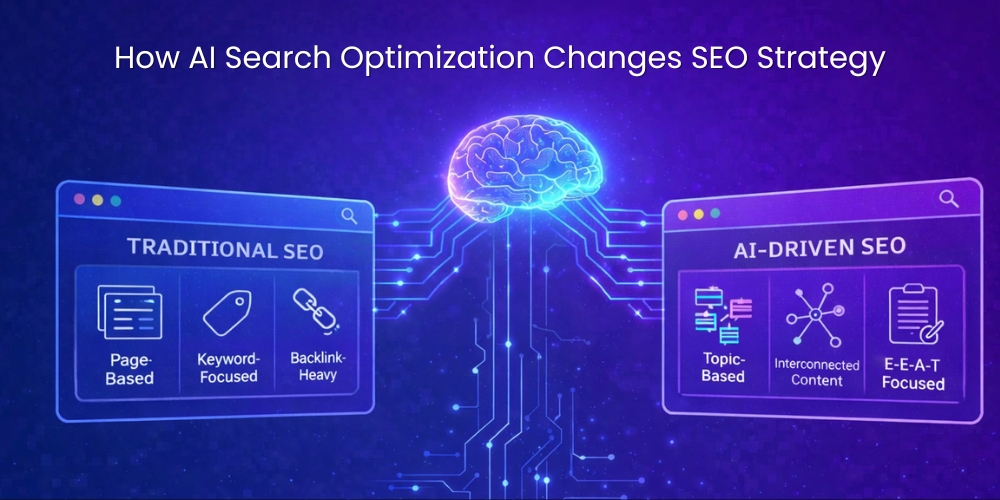
The AI search or SEO Is Now Topic-Centric, Not Page-Centric
Instead of optimizing individual pages for single keywords, AI-driven search favors topic authority.
This means:
- Creating interconnected content clusters
- Covering topics comprehensively
- Building internal relationships between pages
AI recognizes brands that own a topic rather than those targeting isolated keywords.
The Final Thoughts
Intelligence, Faith, and Trust are the three strong pillars of AI search. Modern content is all about educating your audience rather than imposing loads of unnecessary information on them.
Further, practice writing content that is more realistic and delivers accurate information to the searchers.
Once you adapt these improvisations, then no one holds you back from ranking on an AI search. So, these are the AI search optimization that will affect ranking signals in 2026.
Are you looking for a professional company with the best industry experience in ranking content across numerous AI search platforms?
If so, your search ends with Leading Edge Info Solutions. Get in touch with an expert team and see how we can make a difference.
Frequently Asked Questions
In simple terms, it means the content must be written by a niche expert, provide true and appropriate information about the niche, include citations, and, most importantly, include the author’s details so the audience can trust the content and refer others.
For example, let’s assume you enter a physical shoe store, and the moment you step in, the attendant is not attending to you and keeps avoiding you.
How will you feel? Obviously, disrespect and waste of your precious time. In the same manner, AI search will never refer to the website whose loading team is BTL (Below The Line).




 +91- 78377 77045