 Free SEO Audit
 Popular
 SEO
 Google Ads Management
 Ecommerce SEO
 Web Design Service
 White Label SEO


Legal marketing in 2027 requires law firms to adapt their strategies to an evolving search landscape. With search engine result pages (SERPs) heavily incorporating AI-driven answer overviews, local map packs, and conversational search interfaces, relying on traditional keyword-stuffing strategies is no longer effective.
To win high-value legal cases today, attorneys must combine technical compliance, hyper-targeted local optimization, high-authority content, and conversion rate optimization (CRO). Whether managing a boutique practice or a multi-state operation, leveraging tailored SEO services for lawyers is essential for turning search intent into qualified client consultations.
- Target Intent & Conversational Search: Shift focus from rigid keywords to long-tail, intent-driven queries and E-E-A-T principles for AI-driven search overviews.
- Master Local Map Packs: Maintain an accurate Google Business Profile, consistent NAP citations across legal directories, and a steady flow of client reviews.
- Build High-Authority Legal Content: Develop in-depth practice area hubs featuring local statutes, real attorney commentary, and structured case results.
- Prioritize Mobile & Technical Performance: Keep Core Web Vitals under 2.5 seconds and ensure smooth mobile intake forms to capture high-intent traffic.
- Ethical Reputation & Review Building: Automate review requests post-case completion while strictly complying with State Bar confidentiality rules when responding.
- Focus on Quality Backlinks: Earn links from local bar associations, legal journals, non-profit sponsorships, and .edu scholarship programs.
- Maximize Conversion Rates (CRO): Simplify contact forms to 3–4 fields, use clear legal CTAs, and place trust badges near intake areas to boost consultations.
How Legal Search Is Evolving in 2027
Search engines now prioritize user intent, authority, and conversational context over exact-match legal terms. Modern consumers rarely search using rigid phrases like “personal injury attorney Atlanta Georgia.” Instead, they use natural language queries such as “What should I do right after a multi-car accident in Fulton County?”
To rank effectively in 2027, legal content must directly address these nuanced, long-tail questions while satisfying Google’s E-E-A-T (Experience, Expertise, Authoritativeness, and Trustworthiness) criteria.
| Did You Know? Modern AI-powered search engines analyze the semantic relationships between legal practice terms. If a website covers “truck accident litigation” without detailing “FMCSA regulations,” “black box data preservation,” or “spoliation letters,” search algorithms may deem the content incomplete and lower its rank. |
Strategies for Local SEO & Multi-Location Map Packs
For most practice areas, including family law, criminal defense, estate planning, and personal injury, local visibility drives the highest conversion rates. Appearing in the local “3-Pack” (the map section at the top of Google results) requires dedicated geographic optimization.
Optimizing Your Google Business Profile (GBP)
- Precise Categorization: Set your primary category to reflect your core specialty (e.g., Personal Injury Attorney rather than general Law Firm).
- Night-and-Day Consistency: Ensure your Name, Address, and Phone Number (NAP) match across all legal directories (Avvo, Justia, FindLaw, Martindale-Hubbell).
- Geo-Tagged Visual Content: Upload regular photos of your office interior, legal team, and community involvement with embedded location metadata.
| Local SEO Metric | Optimization Action | Impact on Legal Leads |
| GBP Primary Category | Specific legal niche (e.g., Criminal Justice Attorney) | High relevance for targeted local searches |
| Review Velocity | Steady influx of 3–5 reviews monthly | Increases map pack inclusion chances |
| Local Citations | Standardized NAP across legal directories | Builds location credibility and domain trust |
Ready to Claim the Top Spot in Your Local Map Pack?
Find out how our specialized local search strategies put your law practice directly in front of nearby clients actively seeking legal assistance.
High-Intent Legal Content Marketing
Content remains a key driver of organic leads, but 2027 demands deeper focus on context and authority rather than high page counts. Modern law firm SEO focuses on answering high-intent questions that signal a user’s readiness to hire an attorney.
Developing Comprehensive Practice Area Pages
Rather than creating shallow, 300-word summaries for every sub-service, develop comprehensive hub pages supported by detailed topical clusters.
- State-Specific Statutes: Reference local laws, statutes of limitations, and court administrative procedures directly.
- First-Person Attorney Insights: Add commentary from lead counsel explaining how specific legal processes unfold in practice.
- Structured Case Outcomes: Highlight anonymized case studies, settlement histories, or verdict summaries to validate firm capability.
| Did You Know? Incorporating detailed legal glossaries and plain-language definitions on service pages helps capture conversational queries from voice assistants and mobile devices. |
Technical SEO and Mobile Optimization for Law Firm Websites
Legal prospects are frequently stressed, on mobile devices, and seeking immediate help, such as someone searching for a bail bond or DUI attorney late at night. Technical performance directly impacts both search ranking and visitor retention.
Essential Technical SEO Benchmarks for Law Firms
- Core Web Vitals: Maintain a Largest Contentful Paint (LCP) under 2.5 seconds and a Cumulative Layout Shift (CLS) near zero.
- Mobile-First Indexing: Ensure intake forms, click-to-call buttons, and navigational elements are easy to use on mobile screens.
- HTTPS & Data Security: Legal consumers share confidential details. SSL encryption and secure data handling are essential for visitor trust and compliance.
| Pro Tip: Avoid unoptimized third-party chat widgets that load heavy external scripts before primary page content finishes rendering. Sluggish chat scripts degrade Core Web Vitals, increasing bounce rates before prospects even interact with your firm. |
Building Trust Through Online Reviews and Reputation Management
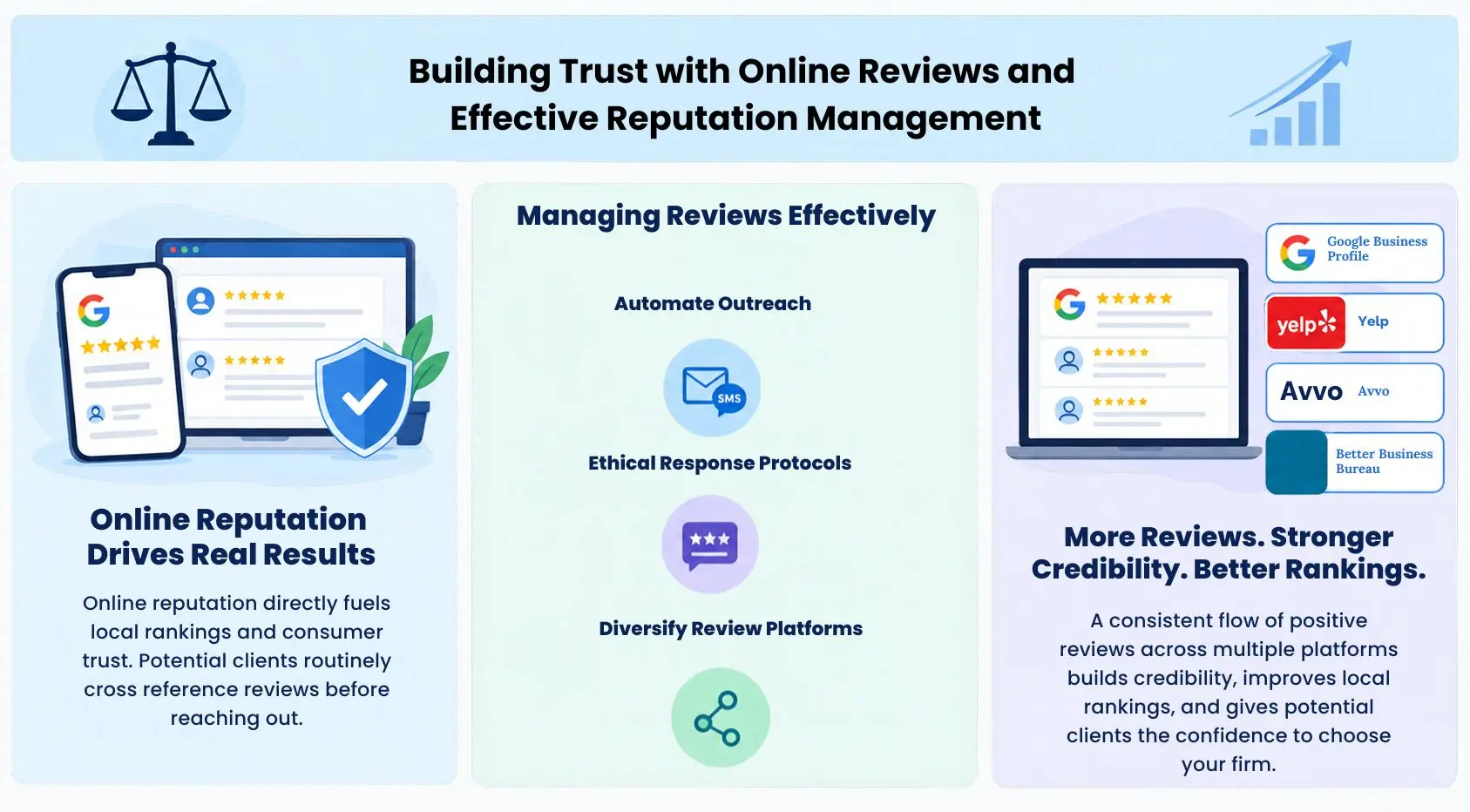
Online reputation directly fuels local rankings and consumer trust. Potential clients routinely cross-reference reviews before reaching out.
Managing Reviews Effectively
- Automate Outreach: Implement post-resolution workflows that request feedback via SMS or email following successful client outcomes.
- Ethical Response Protocols: Respond to every review professionally. Never reveal confidential case details or confirm an attorney-client relationship when replying to negative feedback, as doing so risks violating State Bar ethics rules.
- Diversify Review Platforms: While Google Business Profile takes priority, maintaining positive reviews on Yelp, Google, Avvo, and the Better Business Bureau reinforces legal authority.
| Did You Know? Search algorithms evaluate the sentiment and keywords within client reviews. Reviews mentioning specific legal outcomes (e.g., “helped settle my truck accident claim quickly”) help search engines associate your practice with those specific services. |
Authoritative Link Building in the Legal Niche
Backlinks remain a key ranking factor for competitive search terms like “personal injury attorney” or “corporate litigation firm.” However, low-quality link building can lead to algorithmic penalties.
Effective Link Building Strategies
- Local Community Engagement: Sponsor local non-profits, bar association events, or legal aid clinics to secure legitimate .org and .edu backlinks.
- Legal Thought Leadership: Publish commentary, legal analysis, or op-eds in recognized publications, legal journals, and regional news sites.
- Scholarship Programs: Host annual law school scholarships to gain high-authority links from university domains (.edu).
Want to Outrank Top Legal Competitors in Your Practice Area?
Build domain authority safely with custom link-building and content marketing strategies designed specifically for modern law practices.
Converting Search Traffic into Retained Clients (CRO)
Attracting website visitors is only half the battle; converting them into consultations is where revenue is generated. Implementing Conversion Rate Optimization (CRO) ensures your marketing budget produces measurable results.
Essential Conversion Elements
- Prominent Calls-to-Action (CTAs): Position clear, action-oriented buttons (e.g., “Schedule Your Confidential Consultation”) above the fold on every page.
- Simplified Contact Forms: Limit initial contact forms to 3-4 essential fields (Name, Phone, Email, Brief Description) to reduce drop-off.
- Trust Badges & Accolades: Display recognizable legal badges (Super Lawyers, Martindale-Hubbell AV Preeminent, Best Lawyers) near contact areas to reinforce credibility.
Achieving Sustainable Growth with Leading Edge Info Solutions
At Leading Edge Info Solutions, we help law firms strengthen their online presence through strategic law firm SEO. Our tailored SEO services for lawyers focus on improving search visibility, reaching potential clients, and supporting sustainable growth in an increasingly competitive legal market.
From custom local map strategies and technical site optimization to legal content creation and conversion rate optimization, LEIS equips law practices with tailored solutions designed to outrank competitors and turn website visitors into signed clients.
Grow Your Caseload Without Chasing Leads
Spend less time chasing potential clients and more time focusing on your practice. At Leading Edge Info Solutions (LEIS), we help law firms attract qualified leads through tailored SEO and digital marketing strategies designed to bring the right clients to you.