 Free SEO Audit
  Popular
 SEO
SEO
 Google Ads Management
 Ecommerce SEO
 Web Design Service
 White Label SEO

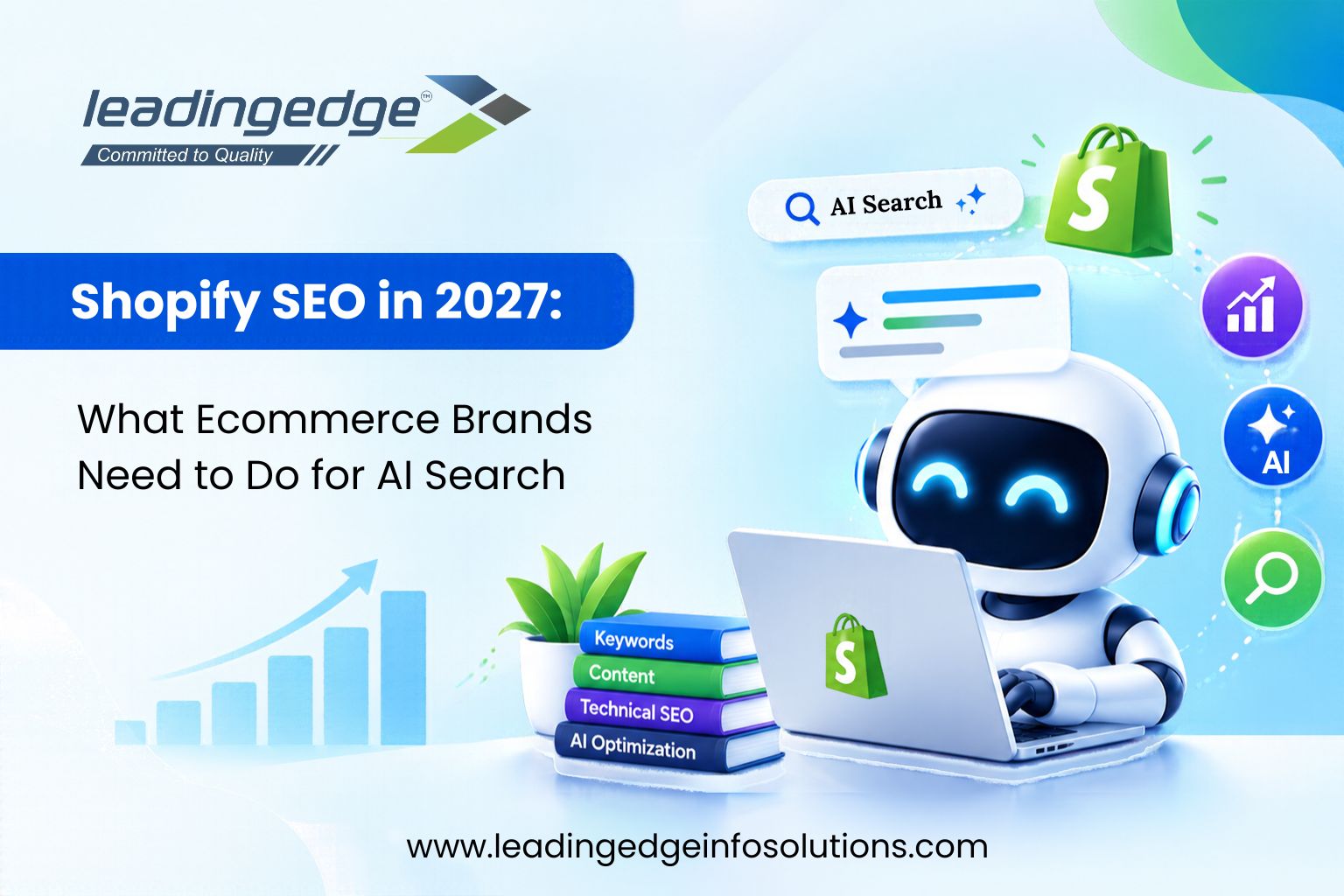
Quick answer: To win AI search with Shopify SEO in 2027, make your store easy to crawl, your product data complete and consistent, your pages answer-first, your brand credible beyond your own site, and your AI visibility measured. Work through those five layers in that order.
On March 24, 2026, Shopify expanded Agentic Storefronts to millions of eligible merchants, making Shopify products discoverable across AI shopping channels including ChatGPT, Microsoft Copilot, Google AI Mode, and Gemini. The exact shopping and checkout experience varies by channel and merchant eligibility.
That changes what Shopify SEO means. The question for 2027 is no longer whether AI can see your store. It is whether AI will choose it. That choice depends on things you control: how clean your product data is, how clearly your pages answer buyer questions, and how trustworthy your brand looks across the web.
- Shopify SEO is evolving: AI search is changing how shoppers discover and evaluate products.
- Technical SEO still matters: Strong crawlability, indexation, and site structure remain essential.
- Optimize product data: Keep product details, pricing, availability, and structured data accurate and consistent.
- Create answer-first content: Address real customer questions, product use cases, comparisons and buying concerns.
- Build brand authority: Reviews, original content, expert insights, and credible mentions strengthen trust.
- Measure AI visibility: Track AI recommendations, branded searches, referrals, and citations alongside traditional SEO metrics.
How AI Search Is Changing Shopify SEO
Three shifts matter most for ecommerce brands.
- Queries are longer and more specific. Shoppers type full situations, like “waterproof jacket for light hiking under $200,” instead of “rain jacket.” A page that answers the specific situation can be cited even if it does not rank first for the short keyword.
- The click is no longer guaranteed. Some questions are answered on the results page, and some purchases can now happen inside the AI surface itself. Being cited still earns visibility and brand recall, but your traffic reports will no longer tell the whole story.
- Product research and product discovery are merging. The “what should I look for” stage and the “what should I buy” stage now happen in one conversation, so your content has to serve both.
That means your Shopify SEO strategy needs to support both informational intent and commercial intent.
Your product pages, collections, guides, FAQs, and supporting content should work together rather than existing as isolated pages.
What Shopify Stores Need to Know About AI Shopping
Shopify’s Agentic Storefronts make eligible products available across AI shopping experiences. Products can be discovered through Shopify Catalog, while Google AI Mode and Gemini use product information available through Google Merchant Center and the Google & YouTube channel.
The important distinction is that eligibility does not guarantee recommendation.
AI systems still decide which products to surface based on the shopper’s request, available product information, and other signals.
AI Shopping at a Glance
| AI Surface | What Shoppers Get | Checkout |
| Google AI Mode and Gemini | AI answers with product listings | Direct checkout for select US merchants through Google’s Universal Commerce Protocol (UCP) |
| ChatGPT | Product recommendations from Shopify Catalog | Typically completed on the merchant’s own store |
| Microsoft Copilot | Product recommendations | In-chat checkout for eligible merchants |
Availability and checkout options can change, so Shopify merchants should check their current Agentic Storefront settings and channel eligibility rather than assuming every feature is available to every store.
| Did you know? Shopify’s current Agentic Storefronts setup allows merchants to manage AI channels centrally from Shopify Admin and see performance information such as AI-channel orders, sales, and conversions. |
The 5-Layer Shopify SEO Framework for AI Search
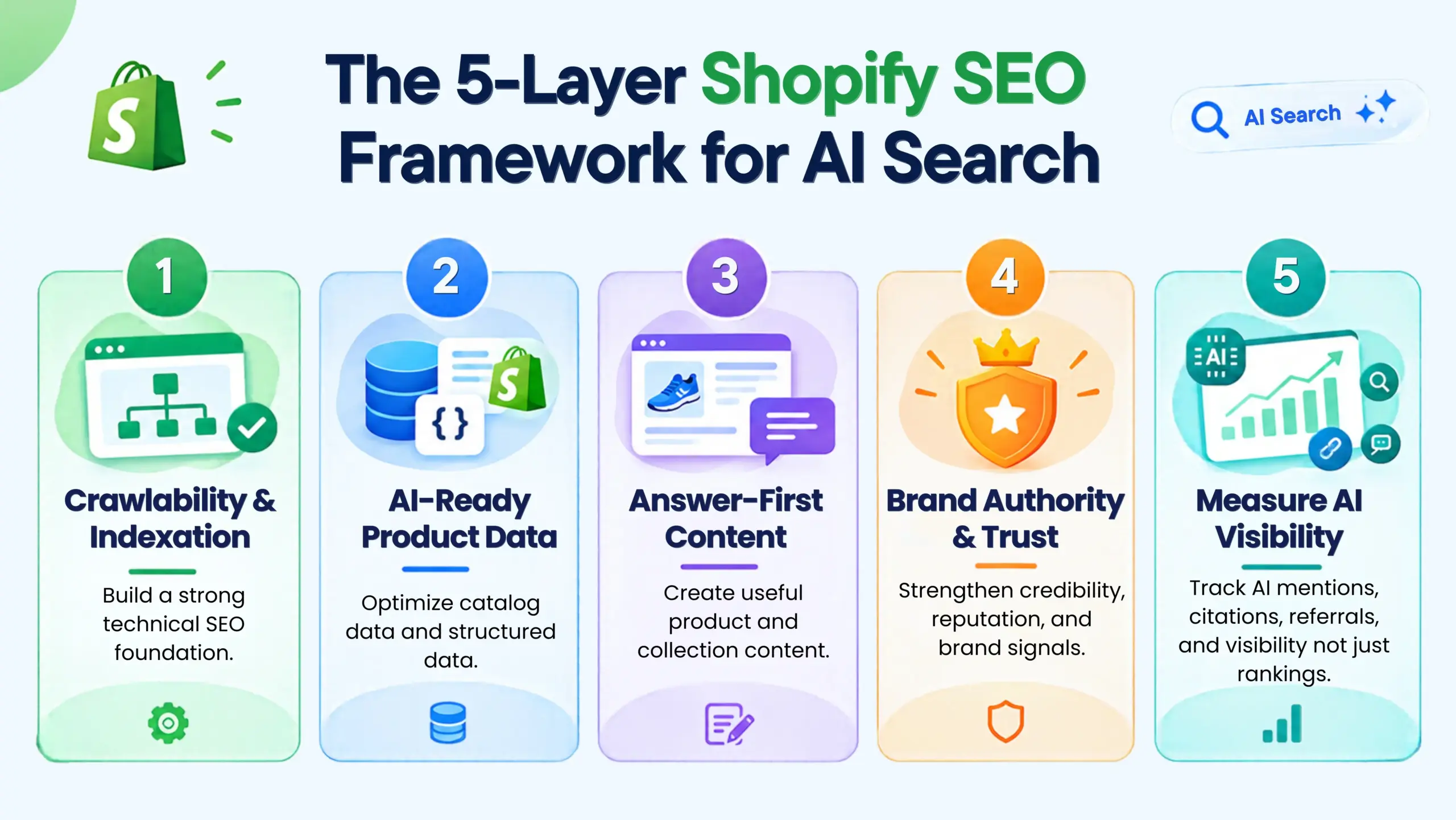
Layer 1: Build a Strong Crawlability and Indexation Foundation
For Google AI search features, crawlability and indexation remain foundational. For AI shopping channels, however, product catalogs and feeds can also determine what information is available to the system. Start here:
- Compare the product pages indexed in Google Search Console with the products in your Shopify admin.
- Confirm canonicals point to /products/handle, not /collections/…/products/handle.
- Review robots.txt.liquid so you are not blocking key sections by mistake.
- Noindex tag and filter pages that have no reason to rank.
- Remove apps and leftover code that slow mobile pages, and audit your app stack every quarter.
| Pro tip: If Search Console shows a pile of “Discovered, currently not indexed” pages, consolidate near-duplicates instead of resubmitting them. Thin, repetitive pages are a quality signal problem, not a crawling problem. |
Layer 2: Make Your Product Data AI-Ready: Catalog Data and Structured Data
Most Shopify stores neglect this layer. AI channels pull from Shopify Catalog, and Google’s AI shopping surfaces pull from Merchant Center. Both reward complete, consistent data.
- Include brand, GTIN or MPN, price, availability, material, size, and color on every product.
- Store specs in metafields (for example, material, fit, waterproof rating, compatibility) so they appear in a consistent format across the catalog.
- Keep price and stock identical across your product page, feed, and structured data. Mismatches cause disapprovals and confuse everything downstream.
- Implement accurate Product and Offer structured data where appropriate, and make sure it matches the information visible on the page. Many themes output only part of it, so test pages in Google’s Rich Results Test and fill the gaps.
- For Google’s in-chat Buy button (select US merchants), products need the native_commerce attribute and UCP onboarding in the Merchant Center.
| Did you know? Shopify products can reach AI shopping channels through more than one route. Shopify Catalog is one pathway, while Google AI Mode and Gemini rely on product information available through Google Merchant Center. This is why keeping product data synchronized matters. |
Layer 3: Create Answer-First Product and Collection Content
Manufacturer blurbs give AI little to extract. Write for the questions a good store assistant would answer:
- Who the product is for, and who it is not for
- Specs in plain language: waterproof rating, fit, care
- A short “how to choose” block comparing it with your other products
- Four to six FAQs from customer emails, chat, and reviews, with the direct answer in the first sentence
Here is an illustrative before-and-after.
Before: “The Storm Series jacket blends style and performance for the modern adventurer, crafted from premium materials.”
After: “Waterproof to 10,000 mm with fully taped seams. Best for light hiking and daily rain, not for sub-zero conditions. Runs slightly narrow through the shoulders, so size up if you layer a fleece.”
The second version gives a shopper, and an AI system, facts to quote and a clear sense of fit.
Give collection pages the same treatment: a short intro that defines the category, a “how to choose” section below the products, answers to two or three category-level questions, and links to related guides. Then support each collection with educational content, such as a guide on choosing the right jacket for your climate, linking back to the relevant products. This cluster structure shows topical depth. Besides this, check your return data. The top three reasons customers send a product back are the three questions its page should answer.
Turn Your Product Pages Into Search Assets
If your Shopify product pages still rely heavily on manufacturer descriptions or generic copy, Leading Edge Info Solutions can help identify the pages with the greatest opportunity for SEO, AI search visibility, and conversion improvement.
Layer 4: Brand Authority & Trust
AI systems lean on sources that look trustworthy across the web, not only on your own domain.
- Use original photos and video instead of supplier images.
- Ask buyers for use-case details (“bought for a 10-hour flight”) and reply to reviews with useful information.
- Name real authors or founders on buying guides.
- Earn mentions through digital PR, original data, and honest inclusion in roundups. Avoid bought links and mass guest posting.
- Keep your brand name, description, and profiles consistent everywhere, and add Organization schema.
- Mark up only reviews that appear on the page and come from real customers.
| Pro tip: Treat every unlinked brand mentioned as a lead. Search your brand name monthly, then reply with a thank-you and a helpful resource. One real relationship with a trusted site does more for AI visibility than ten bought links. |
Layer 5: Measure AI Visibility, Not Just Rankings
Traditional Shopify SEO reporting often focuses on:
- Rankings
- Organic traffic
- Click-through rates
- Conversions
Keep tracking them. But add AI-specific measurements.
| What to Track | Where to Look | Why It Matters |
| Impressions on question-style queries | Google Search Console | Shows demand for conversational searches |
| Branded search growth | Search Console, Google Trends | Signals rising brand awareness |
| AI-channel orders and referrals | Shopify admin, GA4 | Connects AI visibility to revenue |
| Citations in AI answers | Monthly prompt test | Shows whether you are being named |
Be aware that checkout inside AI surfaces may not map cleanly to a classic GA4 or pixel-based funnel, so reconcile with Shopify orders and Merchant Center reports rather than relying on one dashboard.
Run a Monthly AI Visibility Test
Write 20 prompts across four types:
- Discovery: “best trail running shoes for flat feet”
- Comparison: “[Product A] vs [Product B]”
- Problem: “how do I stop my jacket from wetting out”
- Brand: “is [your brand] worth it?”
Run them in AI Overviews, AI Mode, ChatGPT, Gemini, and Copilot. Log whether you are mentioned, which competitors appear, and which pages are cited. Repeat monthly and look for patterns: Look for patterns in the pages that earn citations, such as specificity, first-hand information, clear answers, product evidence, and strong topical relevance, and use those patterns to improve your own pages.
Measure Where Your Brand Appears in AI Search
Not sure whether ChatGPT, Google AI Mode, or other AI platforms are actually mentioning your brand? An AI search visibility assessment from Leading Edge Info Solutions can help identify where your brand appears, where competitors are gaining visibility, and which content opportunities deserve attention.
Common Mistakes to Avoid
- Chasing “AI hacks” while crawl and indexation problems remain. If a page is not indexed, nothing else matters.
- Mass-producing generic AI-written descriptions. Thin copy gives systems no reason to prefer you.
- Adding a schema that does not match the page. Inaccurate markup erodes trust.
- Ignoring Merchant Center. It is now central to how Google understands your catalog.
- Letting data drift. A price or stock mismatch between your page and feed can undo good work.
- Measuring only rankings. Impressions, brand searches, and revenue provide detailed insights.
Three Myths About Shopify AI SEO
- “Schema guarantees citations.” It does not. It removes ambiguity about what your page says.
- “I need a separate AI feed.” For Google AI Mode, you do not.
- “If I’m discoverable, I’ll be recommended.” Discoverable only means eligible.
Your 2027 Shopify SEO Roadmap
You don’t need to overhaul your entire store overnight.
Break the work into four stages.
Q1: Audit the Foundation
Focus on:
- Crawlability
- Indexation
- Canonicals
- Internal linking
- Product data
- Structured data
- Merchant Center
Q2: Improve Your Highest-Value Pages
Start with:
- Top-selling products
- Highest-traffic collections
- High-margin products
- Pages with strong impressions but weak conversions
- Pages with strong commercial potential but limited visibility
Rewrite them around actual customer questions.
Q3: Build Authority and Supporting Content
Develop:
- Buying guides
- Product comparisons
- Original research
- Customer-driven content
- Expert content
- Digital PR opportunities
Connect these resources back to relevant products and collections.
Q4: Measure and Refine
Review:
- AI visibility
- Organic search performance
- Branded searches
- Product discovery
- AI-channel traffic
- Revenue
- Conversion rates
Then identify which content and product pages are gaining visibility and expand what is working.
Final Thoughts
AI search rewards stores that make it easy to trust them: clean data, clear answers, real proof, and a reputation that exists beyond the store. Start with Layer 1, move through all five, and test monthly so you can see what is working.
Want to know how your Shopify store performs across traditional and AI search? Talk to Leading Edge Info Solutions about an AI search and Shopify SEO audit.