
 Free SEO Audit
  Popular
 SEO
SEO
 Google Ads Management
 Ecommerce SEO
 Web Design Service
 White Label SEO

With Google’s continued emphasis on Core Web Vitals and the growing adoption of AI-powered search experiences such as Google AI Overviews, ChatGPT Search, Perplexity, and other generative search platforms, website performance, structure, and content organization play an increasingly important role in online visibility and user experience.
As a result, choosing a website is no longer just a design decision in 2026; it’s a long-term business investment. The platform you build on affects everything from page speed and SEO to scalability, security, maintenance costs, and your ability to adapt as your business grows.
That brings us to one of the most important decisions businesses face today: custom website design vs. templates. Which approach delivers better long-term value, and which is more likely to create technical limitations as your business grows?
In this guide, we’ll compare both approaches across cost, performance, scalability, SEO, and long-term ROI to help you choose the right solution for your business.
Quick Comparison: Custom Web Design vs. Templates
| Key Metric | Template Website (Themes/Page Builders) | Custom Website Design (Tailored Code) |
| Upfront Cost Range | $500 – $2,500 (Low initial spend) | $5,000 – $25,000+ (Capital investment) |
| Time to Launch | 1 to 3 Weeks | 6 to 12+ Weeks |
| Core Web Vitals & Speed | Vulnerable to plugin bloat & heavy CSS/JS | Fully clean, minimal, performance-optimized code |
| SEO & AI Search (AEO) | Generic baseline schema; restricted URL control | Bespoke JSON-LD Schema; optimal crawl efficiency |
| Scalability & Integrations | Limited by theme ecosystem & third-party plugins | Unlimited API integrations, CRMs, & custom logic |
| 3-Year Total Cost of Ownership | High hidden maintenance, plugin fees, & rebuilds | Stable maintenance, zero architectural re-platforming |
Template Website Pros and Cons: What Businesses Should Know
Understanding the template website pros and cons helps businesses determine whether a pre-built solution will meet their current needs or create limitations as they grow. Templates built on platforms like WordPress, Shopify, or Webflow serve a clear purpose in the digital landscape: accessibility and speed.
The Advantages (Template Website Pros)
- Immediate Market Entry: Pre-designed wireframes allow startups to launch a functional site or campaign landing page within days.
- Low Initial Capital Requirement: Lower upfront costs make templates appealing for businesses testing a new market or validating demand.
- Built-in Content Editing: Standard block editors enable non-technical teams to make simple text and image updates independently.
The Drawbacks (Template Website Cons)
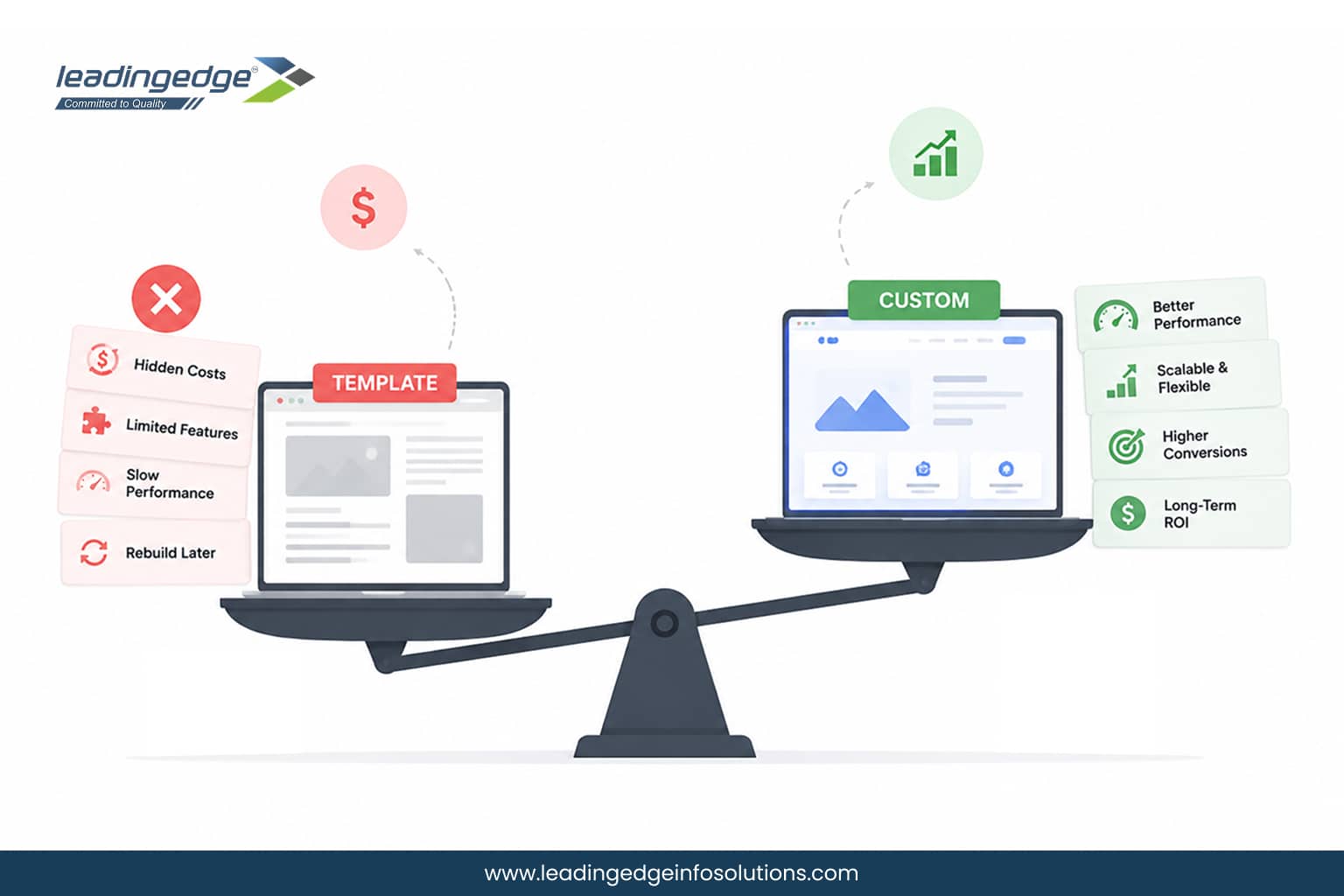
- The “Plugin Bloat” Performance Trap: Extending a template’s functionality requires adding external plugins, which can degrade Core Web Vitals over time.
- Design Identity Constraints: Your site risks looking visually similar to hundreds of competitors using the same base theme.
- Customization Ceilings: Modifying template layouts beyond their designed parameters often requires complex CSS overrides that lead to display bugs on mobile devices.
Signs You’ve Outgrown Your Website Template
Many small businesses start on a simple template and run into severe friction as they scale. You have likely outgrown your current template platform if:
- Pages load slowly despite optimization: Template platforms accumulate heavy background code that hinders performance, dropping your mobile core web vitals and search rankings.
- Plugin conflicts become common: You are patching together third-party apps to add features, causing site breakages, security risks, or expensive monthly app fees.
- You require custom CRM or API integrations: Off-the-shelf builders cannot natively sync with your internal inventory, customer portals, or specialized software.
- Expansion requires multi-location support: You need localized landing pages, distinct service areas, or dynamic content routing that fixed navigation bars can’t handle cleanly.
- Conversion rates plateau: Your traffic keeps increasing, but lead volume stays flat because you cannot customize user journeys or A/B test layout structures.
Is Your Website Holding Back Business Growth?
Slow load times, poor Core Web Vitals, and outdated website architecture can impact both user experience and search visibility. Explore how our tailored Web Development Services and strategic UI/UX Design solutions can help transform your online presence.
Why Custom Websites Outperform Templates in Competitive Industries
To understand why custom websites often outrank and out-convert template builds in competitive sectors, you have to look beneath the surface at the underlying site architecture.
According to guidelines published on Google’s web.dev Core Web Vitals resource, search engines evaluate page experience based on how fast content renders and how stable the page remains as it loads. Custom builds excel in these technical areas:
- Lean Code & Minimal DOM Depth: Page builders and pre-made themes inject excessive <div> wrappers, inline styling, and unused JavaScript libraries. Custom development delivers a clean Document Object Model (DOM) tree, allowing search engine bots to crawl and parse pages faster.
- Fewer Render-Blocking Assets: Templates often load site-wide CSS and JavaScript files on every page—even on pages that don’t use those elements. Custom sites load only the specific assets required for that page, drastically improving Interaction to Next Paint (INP) and Largest Contentful Paint (LCP) scores in Google PageSpeed Insights.
- Bespoke JSON-LD Schema Implementation: AI-powered search engines rely on structured data to pull facts directly into answer boxes. While templates rely on rigid, automated plugin schema, custom code allows developers to map precise, entity-level schema tailored specifically to your services, locations, and organization hierarchy.
- Scalable & Secure Architecture: Third-party plugins are a leading vector for website vulnerabilities and malware infections. A custom-coded site minimizes reliance on external plugins, providing tighter security and seamless third-party API integrations (CRMs, ERPs, custom booking engines) that won’t break during CMS updates.
Financial Breakdown: Custom Web Design Cost vs. Website Design ROI
Looking beyond upfront pricing is essential when evaluating website design ROI in 2026. Businesses should consider maintenance costs, scalability, conversion improvements, and long-term revenue instead of focusing only on the initial development budget.
Uncovering the Hidden Costs of Templates
While a template site appears inexpensive on day one, recurring expenses accumulate over time:
- Premium security, cache, and SEO plugin licenses ($500–$1,500/year)
- Regular developer hours required to fix plugin compatibility conflicts
- The eventual “Re-Platforming Penalty” when the business outgrows the theme and requires a full rebuild
Real-World Website Design ROI
Depending on industry, traffic quality, and UX improvements, businesses often experience measurable gains in conversion rates after migrating from slow, template-based websites to performance-focused custom builds.
For a site generating significant organic traffic, even a modest lift in conversion rates, driven by faster mobile load times and a frictionless user journey, can generate substantial additional revenue, helping justify the higher upfront investment over time.
Custom Web Design vs. Templates: Which One is Right for You
Knowing when to choose custom web design depends on your business goals, expected growth, and how important your website is to lead generation and sales. The table below provides a practical framework to help you decide.
| Business Situation | Recommended Approach | Primary Reason |
| Startup Validating an Idea | Template | Low financial risk and rapid deployment for MVP testing. |
| Small Brochure Website | Template | Basic informational needs with minimal dynamic features. |
| Local Service Business | Depends | Templates work for low competition; custom works better for aggressive multi-location scaling. |
| SaaS Company | Custom | Requires bespoke interactive UI, product demos, and deep API integrations. |
| Enterprise Brand | Custom | Demands rigorous enterprise security, clean DOM structures, and multi-tier user workflows. |
| E-commerce Scaling Brand | Custom | Needs custom checkout flows, fast product filtering, and high concurrency performance. |
Strategic Guidance from Leading Edge Info Solutions
Choosing between custom website design vs. templates isn’t simply a question of budget—it’s a decision that influences your website’s performance, scalability, search visibility, and long-term return on investment. While template websites can be an excellent starting point for early-stage businesses, custom website design provides the flexibility and technical foundation needed to support sustainable growth in today’s AI-driven search landscape.
For more than 14 years, Leading Edge Info Solutions (LEIS) has helped businesses across healthcare, e-commerce, manufacturing, legal, education, and professional services build websites that balance technical performance with measurable business outcomes. Our multidisciplinary team combines custom web development, SEO services, technical SEO audits, and digital marketing strategies to create websites that are fast, scalable, secure, and built to convert.
Whether you’re weighing the template website against custom, evaluating custom web design cost, or calculating your expected website design ROI, choosing the right approach should align with your long-term business strategy rather than just your initial budget.
Contact LEIS for a tailored consultation and website strategy